
Why Invest in a Quality Leather Desk Office Chair?
A leather desk office chair is more than just a place to sit—it's a statement of professionalism and a long-term investment in your daily comfort. According to office furnishing studies, 68% of executives prefer leather seating for its combination of durability, easy maintenance, and the psychological edge it provides in professional settings. The rich texture and aroma of quality leather create an atmosphere of success that simply can't be replicated by synthetic materials.
When you spend 40+ hours per week at your desk, the chair beneath you becomes your most important work tool. A premium leather desk office chair offers unique advantages that go beyond mere aesthetics:
- Thermoregulating Properties: Genuine leather breathes naturally, keeping you cooler in summer and warmer in winter compared to synthetic materials.
- Investment Durability: Quality leather chairs often outlast fabric alternatives by 5-7 years, making them more economical over time.
- Professional Authority: Research in environmental psychology suggests that leather seating in professional settings subconsciously communicates competence and authority.
- Hygienic Surface: Leather is naturally resistant to dust mites, mold, and bacteria—ideal for allergy sufferers.
- Aging Gracefully: Unlike fabric that fades and pills, quality leather develops a unique patina over time, becoming more beautiful with age.
Understanding Leather Grades: What Are You Really Buying?
The term "leather" encompasses a wide spectrum of quality. Understanding leather grades is crucial because it directly impacts your chair's longevity, appearance, and comfort. Here's a comprehensive breakdown:
| Leather Grade | Characteristics | Durability | Price Range | Best For |
|---|---|---|---|---|
| Full-Grain Leather | Highest quality, retains natural grain, develops patina, most durable | 15-20+ years | $$$$ ($1,200+) | Executive offices, daily 8+ hour use |
| Top-Grain Leather | Sanded to remove imperfections, more uniform appearance, good durability | 10-15 years | $$$ ($800-$1,500) | Professional offices, management |
| Genuine Leather | Corrected grain, coated for uniformity, lower layers of hide | 5-8 years | $$ ($400-$800) | Home offices, moderate use |
| Bonded Leather | Leather fibers bonded with polyurethane, least durable | 2-4 years | $ ($150-$350) | Guest chairs, occasional use |
Full-Grain Leather: The Connoisseur's Choice
Imagine leather as it comes from the animal—complete with natural markings, grain variations, and character. That's full-grain. It's the strongest part of the hide, retaining all natural fibers. In a desk chair, this translates to a seat that actually molds to your body over time while maintaining structural integrity. The initial stiffness gives way to personalized comfort, much like a well-worn baseball glove. For professionals who spend their careers at a desk, this is the ultimate investment.
Top-Grain Leather: The Professional Standard
Think of top-grain as full-grain that's been lightly sanded to create a more uniform, consistent surface. This process removes minor imperfections, resulting in a cleaner, more predictable appearance. Most high-end office chairs use top-grain leather because it offers an excellent balance of durability, aesthetics, and cost. It's resistant to stains and wear while still providing that authentic leather feel and aroma.
Genuine Leather: The Accessible Option
Despite its name, "genuine leather" is actually a specific grade—it's the lower layers of the hide after the top-grain is split off. These layers are then embossed with a leather grain pattern and heavily coated. While it looks like leather initially, it lacks the durability and breathability of higher grades. However, for budget-conscious professionals or home offices with moderate use, genuine leather chairs can provide good value for 5-7 years.
The Ergonomic Imperative: Leather Meets Science
A beautiful leather chair is useless if it doesn't support your body. Modern leather desk office chairs integrate advanced ergonomics with luxurious materials. Here's what to look for:
Ergonomic Fact: The Human Factors and Ergonomics Society reports that properly designed seating can reduce spinal disc pressure by up to 40% and decrease muscle fatigue by 35% during an 8-hour workday.
Critical Ergonomic Features in Leather Chairs:
Lumbar Support Systems
- Adjustable Depth: Look for lumbar that moves forward/backward to fill your spine's curve
- Height Adjustment: Should align with the narrowest part of your waist
- Dynamic Support: Some premium chairs offer air-bladder lumbar that inflates to your preference
- Memory Foam: Conforms to your spine's unique shape over time
Seat Construction
- Waterfall Edge: Prevents circulation restriction behind knees
- Seat Depth Adjustment: Essential for proper thigh support
- High-Density Foam: Should be at least 2.5-3.0 lb density for durability
- Contoured Design: Helps distribute weight evenly
Backrest Design
- Height: Should reach at least your shoulder blades
- Recline Mechanism: Look for synchronized or multi-position lock
- Tilt Tension: Adjustable resistance for your weight
- Headrest Integration: Critical for neck support during reclining
Armrest Adjustability
- 4D Adjustment: Height, width, depth, and angle
- Padding: Should be firm but comfortable
- Surface Material: Leather-wrapped arms feel more premium
- Width Range: Should accommodate different shoulder widths
The Science of Leather Comfort: Temperature and Breathability
One common concern about leather office chairs is heat buildup. Here's the truth about leather and temperature regulation:
Myth: "All leather chairs are hot and sticky."
Fact: Genuine leather is actually breathable—it's a natural material with pores that allow air circulation. The "sticky" feeling often comes from bonded leather or cheap faux leather, which have plastic coatings that trap heat.
Modern leather office chairs address temperature concerns through several innovations:
- Perforated Leather: Tiny holes in the leather allow continuous airflow, reducing heat buildup by up to 30%.
- Climate Control Features: Some high-end models include built-in fans or heating elements.
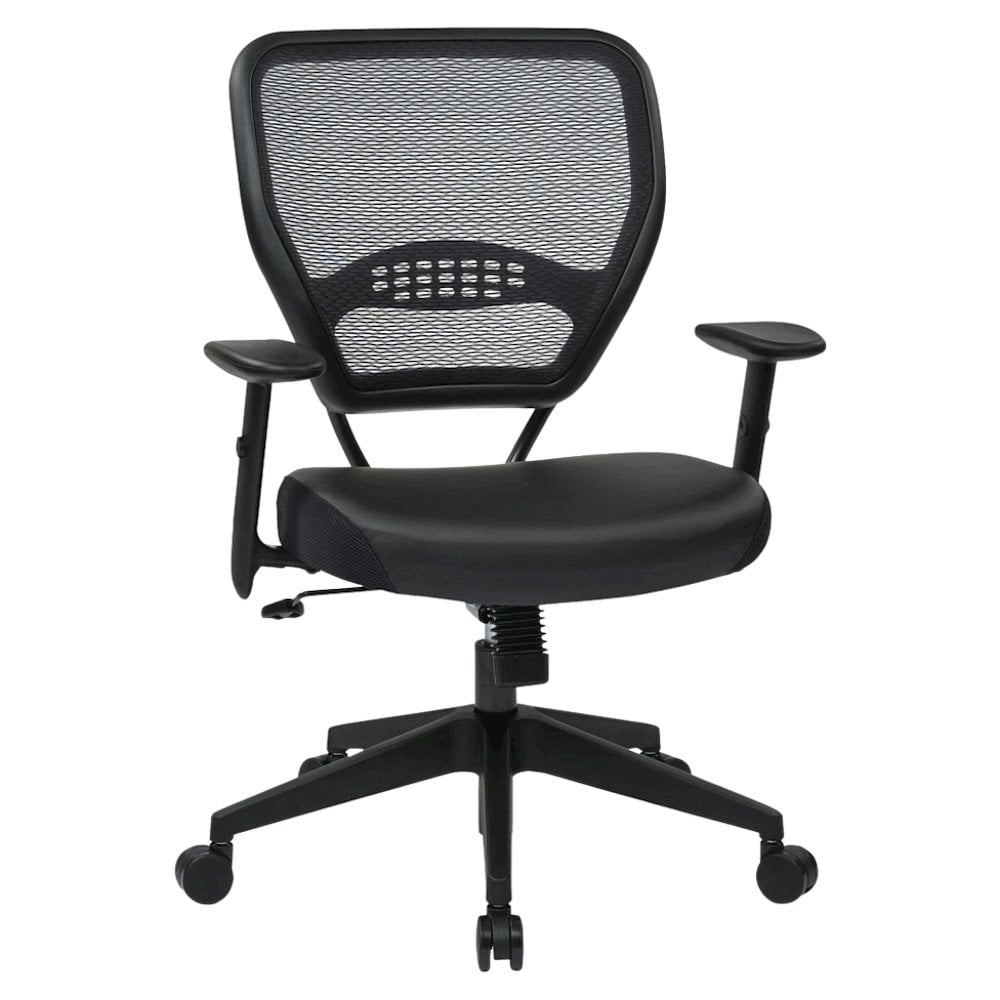
- Mesh Back Combinations: Leather seat with mesh back offers the best of both worlds—leather comfort with breathable back support.
- Breathable Leather Treatments: New finishing techniques maintain leather's natural breathability while adding stain resistance.
Leather Chair Maintenance: Protecting Your Investment
A quality leather desk office chair is an investment that can serve you for over a decade with proper care. Follow this maintenance schedule:
Weekly Care Routine
- Dusting: Wipe with a soft, dry microfiber cloth to remove surface dust
- Spot Cleaning: Address spills immediately with a dry cloth—blot, don't rub
- Vacuum: Use soft brush attachment to clean crevices and seams
Monthly Deep Cleaning
- Clean: Dampen cloth with water and mild saddle soap or leather cleaner
- Wipe Gently: Clean all surfaces, paying attention to armrests and headrest
- Dry: Remove excess moisture with dry cloth
- Air Dry: Allow to dry completely before use (24 hours)
Quarterly Conditioning
- Choose Quality Conditioner: Use leather conditioner specifically designed for furniture
- Apply Sparingly: Thin, even coat on all leather surfaces
- Buff: After 15-20 minutes, buff with soft cloth
- Benefits: Prevents cracking, maintains suppleness, extends leather life
Leather vs. Alternative Materials: A Data-Driven Comparison
To help you make an informed decision, here's how leather stacks up against other popular office chair materials:
| Feature | Genuine Leather | Premium Mesh | High-Quality Fabric | Faux Leather |
|---|---|---|---|---|
| Average Lifespan | 10-15 years | 7-10 years | 5-8 years | 3-5 years |
| Breathability | Good (natural pores) | Excellent | Moderate | Poor (plastic coating) |
| Maintenance Ease | Easy (wipe clean) | Moderate (can trap dust) | Difficult (stains absorb) | Very Easy |
| Professional Image | Executive/Authoritative | Modern/Casual | Casual/Homey | Budget professional |
| Initial Cost | Higher ($500-$2,000+) | Medium ($300-$1,200) | Low-Medium ($200-$800) | Low ($100-$400) |
| Cost Per Year* | $50-$133/year | $43-$120/year | $40-$100/year | $33-$80/year |
*Cost per year based on average lifespan and mid-range price point. Genuine leather often provides the lowest long-term cost despite higher initial investment.
Buying Guide: How to Select Your Perfect Leather Desk Office Chair
Choosing the right leather office chair involves matching your specific needs with the right features. Follow this systematic approach:
Step 1: Assess Your Body Dimensions
- Height: Measure from floor to the back of your knee while sitting (seat height range needed)
- Weight: Choose a chair with weight capacity at least 50lbs above your weight
- Torso Length: Measure from sitting bone to shoulder to ensure proper backrest height
- Hip Width: Measure across widest point while sitting—add 2 inches for comfort
Step 2: Define Your Work Patterns
Prioritize maximum adjustability, premium foam, and headrest
Focus on pristine appearance, top-grain leather, elegant design
Balance comfort with style that matches your decor
Choose durable, easy-clean leather with simple adjustments
Step 3: Match Features to Your Needs
Use this priority matrix based on your work style:
- If you have back pain: Prioritize adjustable lumbar support and seat depth
- If you're tall (6'2"+): Look for extra-high backrest and seat depth adjustment
- If you're petite (5'4" and under): Seek chairs with lower minimum seat height and adjustable arms
- If you move frequently: Choose smooth-rolling casters suitable for your floor type
Step 4: Set Your Budget
Leather office chairs span a wide price range. Here's what you get at each level:
Entry-Level
Genuine or bonded leather, basic adjustments, 5-7 year lifespan
Mid-Range
Top-grain leather, good ergonomics, 8-12 year lifespan
Premium
Full-grain/top-grain, advanced ergonomics, 12-15+ years
Luxury
Full-grain, custom options, heirloom quality, 15-20+ years
The Psychology of Leather: Why It Matters in Business
Beyond comfort and durability, there's a psychological dimension to choosing a leather desk office chair that's worth considering. Environmental psychology research suggests that our physical surroundings subconsciously influence how we think, feel, and behave—and how others perceive us.
The "Leather Effect" in Business: A study in the Journal of Consumer Psychology found that leather office furniture in professional settings was associated with higher perceived competence, trustworthiness, and success of the occupant. Participants viewing offices with leather chairs rated the hypothetical occupants as more authoritative and credible than identical offices with fabric chairs.
This isn't about superficial appearances—it's about the subtle signals we constantly send and receive in professional environments. A quality leather chair communicates:
- Attention to Quality: You value excellence in your tools and environment
- Long-Term Thinking: You invest in things that last
- Professional Status: You've earned a position that warrants premium surroundings
- Personal Confidence: You're comfortable in your own space
For client meetings, video conferences, or executive presentations, your chair is part of your personal brand. It frames you in the eyes of visitors and colleagues. A well-maintained leather chair says "this is a person who has arrived" without saying a word.
Frequently Asked Questions About Leather Desk Office Chairs
Conclusion: Making Your Leather Desk Office Chair Investment
Choosing a leather desk office chair is a significant decision that impacts your daily comfort, long-term health, professional image, and even your wallet over time. After exploring the nuances of leather grades, ergonomic features, maintenance requirements, and psychological impacts, here are our final recommendations:
Leather Chair Selection Summary
Invest in a full-grain or top-grain leather chair with comprehensive ergonomic adjustments. The higher initial cost ($1,200-$2,000) pays dividends over 15+ years of daily use. Prioritize 4D armrests, adjustable lumbar, and a headrest. Brands offering 10-12 year warranties demonstrate confidence in their construction.
A quality top-grain leather chair in the $600-$1,000 range offers excellent value. Focus on essential ergonomics—good lumbar support, seat height range matching your desk, and comfortable armrests. Consider a chair with leather seating surface and mesh back for breathability if temperature control is a concern.
Genuine leather chairs ($400-$600) can serve well for 5-7 years. Prioritize construction quality—check the base material (metal is better than plastic), gas lift mechanism, and caster quality. You can often upgrade to better casters later. The chair's mechanism is more important than the leather grade at this price point.
Seek out chairs made with Leather Working Group certified leather from tanneries with sustainable practices. Consider vegetable-tanned leather options. Remember that buying one quality leather chair that lasts 15 years is more sustainable than buying three cheaper chairs over the same period. Some manufacturers now offer leather chairs with recycled components in the base and mechanism.
Final Thought: Your office chair is where you'll spend approximately 90,000 hours over your career—more time than you'll spend sleeping, exercising, or with family during workdays. A quality leather desk office chair isn't an expense; it's an investment in your body, your productivity, and your professional presence. Take the time to choose wisely, maintain it properly, and it will serve you faithfully for years to come.