
Why Standard Chairs Fail—and What You Actually Need
Imagine trying to fit into a suit that’s two sizes too small. You might squeeze into it, but you’d spend the whole day adjusting, tugging, and feeling restricted. That’s exactly what happens when a taller or heavier person uses a standard office chair. The seat pan digs into your thighs, the armrests are too narrow, and the backrest ends mid-shoulder blade. A comfortable big and tall office chair is like a custom-tailored suit: every dimension is proportioned to support a larger frame, from the reinforced base to the extra-wide seat.
According to a 2023 ergonomics survey, 68% of employees who self-identify as "big and tall" reported chronic back or hip pain directly linked to ill-fitting office chairs. The solution isn’t just more padding—it’s intelligent engineering. In this guide, we’ll break down what makes a chair truly comfortable for big and tall individuals, and how to choose one that lasts for years without sagging or squeaking.
Ergonomic Insight: A properly fitted big and tall chair can reduce lower back pressure by up to 35% compared to a standard chair, simply because the seat depth and lumbar support align with the user’s actual body dimensions. (Source: Human Factors and Ergonomics Society)
Anatomy of a Truly Comfortable Big and Tall Office Chair
Not all "big and tall" labels are created equal. Some chairs simply add a few inches to the seat width, but ignore the weak points: the gas cylinder, the frame, and the foam density. Below, we dissect the five critical components that separate a gimmick from a genuine heavy-duty comfort chair.
1. The Foundation: Steel Frame & Reinforced Base
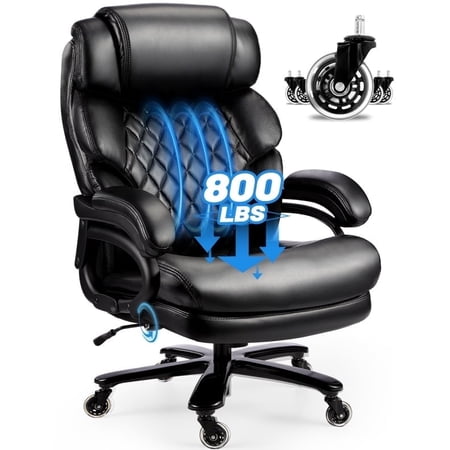
Think of the chair’s frame as its skeleton. Standard chairs often use plastic or thin aluminum. For a comfortable big and tall office chair, you need a solid steel frame—particularly in the backrest and seat pan. The base (the star-shaped part that holds the casters) should be made of heavy-duty nylon or aluminum with a weight rating that exceeds your body weight by at least 50 pounds as a safety margin.
- Look for: "Steel reinforced" or "all-steel frame" in the description.
- Test it: When you sit, the chair should feel rock-solid, with zero wobble.
- Pro tip: A base with a matte finish often indicates thicker, higher-quality material than glossy plastic.
2. The Gas Cylinder: The Hidden Hero
The gas cylinder is the piston that lets you adjust height. Cheap cylinders fail after a few months—you’ve probably experienced a chair that sinks slowly throughout the day. Big and tall chairs require a Class 4 or Class 5 gas lift, which are tested for higher pressures. A Class 4 lift typically supports up to 330 lbs, while Class 5 supports up to 500 lbs or more.
- Keyword to hunt: "Class 4 gas lift" or "heavy-duty hydraulic cylinder."
- Bonus: Some premium chairs offer a 4-inch height range, which is vital for very tall users who need the seat to rise above 22 inches.
3. Seat Dimensions: Width, Depth & Contour
This is where most "big" chairs miss the mark. A comfortable big and tall office chair should have a seat width of at least 22 inches, and preferably 24–28 inches for extra room. But width alone isn’t enough: seat depth (the distance from the back of the seat to the front edge) matters just as much. If the seat is too deep, it will press against your calves; too shallow, and your thighs lack support.
- Ideal depth: 20–22 inches for most tall users. Look for a chair with a sliding seat pan (depth adjustment).
- Cushion density: High-density foam (2.5 lbs per cubic foot or higher) prevents the "bottoming out" feeling after an hour of sitting.
4. Backrest Height and Lumbar Placement
Standard backrests often stop mid-back for tall individuals, offering zero support for the upper spine and shoulders. A true big and tall chair features a high back (usually 28 to 33 inches tall) that supports the entire back, often including an adjustable headrest. Lumbar support must be positioned higher than on a standard chair—look for adjustable lumbar that can move up and down at least 4 inches.
- Check it: When you sit back, the lumbar curve should fit snugly into the small of your back, not your mid-back.
- Material note: Mesh backs are excellent for breathability, but ensure the mesh is tightly woven and has a "stretch test" that shows it won’t sag.
5. Armrests: 4D Adjustability is a Game Changer
Narrow armrests force you to hunch or let your arms dangle, straining shoulders. For big and tall users, armrests should be width-adjustable (move left/right) in addition to height and pivot adjustments. This allows you to position them so your elbows rest at a 90-degree angle without spreading your arms unnaturally.
- What to look for: "4D armrests" or "adjustable armrests (height, width, depth, angle)."
- Material: Soft rubber or gel tops prevent numbness during long meetings.
Quick Specs: Standard vs. Big & Tall Chair
| Feature | Standard Office Chair | Comfortable Big & Tall Chair |
|---|---|---|
| Seat Width | 18–20 inches | 22–28 inches |
| Weight Capacity | 200–250 lbs | 350–500+ lbs |
| Backrest Height | 20–24 inches | 28–33 inches |
| Gas Lift Class | Class 2 or 3 | Class 4 or 5 |
| Seat Depth Adjustment | Rare | Common (essential for tall users) |
The 5-Minute "Fit Test" for Your New Chair
Before you buy, run through this quick mental checklist—or if you’re in a store, test it physically. Use the acronym S.T.R.O.N.G.:
- Seat width: Can you sit with a finger’s width of space on each side?
- Thigh support: Is there a 2-finger gap between the seat edge and the back of your knee?
- Recline tension: Can you lean back without the chair tipping or feeling flimsy?
- Overall stability: Does the base feel solid when you shift weight side to side?
- Neck support: If a headrest exists, does it hit the curve of your neck, not the back of your head?
- Gas lift: Raise it to max—does it hold firm without sinking?
If a chair passes this test, it’s likely a winner. Remember: a comfortable big and tall office chair is an investment in your daily well-being.
Frequently Asked Questions About Big & Tall Office Chairs
Final Verdict: Comfort is Non-Negotiable
Choosing a comfortable big and tall office chair isn't just about luxury—it's about respecting your body's needs. A chair that fits you correctly can prevent chronic pain, improve circulation, and even boost your productivity because you're not constantly shifting to find a comfortable position. Remember the S.T.R.O.N.G. checklist, prioritize steel frames and high-density foam, and don't be afraid to invest a little more upfront for a chair that will serve you for years. Your back (and your bottom) will thank you.
Browse the top-rated options below, and use the filters to find the exact combination of width, material, and adjustability that matches your workspace. Here’s to sitting well!