
Introduction: Why “Healthiest” Goes Beyond Comfort
Imagine your spine as a stack of 33 building blocks. Every hour you spend in a static, unsupportive chair is like gently nudging those blocks out of alignment. The healthiest office chair acts as a stabilizing scaffold, allowing your vertebrae to rest in their natural posture while you focus on your work. It’s not just about padding; it’s about a system of support that works with your body’s physiology.
According to the American Chiropractic Association, 80% of people will experience back pain at some point, with prolonged sitting being a primary contributor. But a well-designed ergonomic seat can reduce spinal disc pressure by up to 40% compared to a standard office chair. This guide dives deep into what defines a truly healthy office chair — from the material of the mesh to the mechanism beneath the seat.
The Anatomy of the Healthiest Office Chair: 5 Critical Systems
Forget flashy looks for a moment. The healthiest chair is an ecosystem of adjustments. Here are the five non-negotiable systems that separate a gimmick from a genuine health tool.
1. Dynamic Lumbar Support: Your Spine's Best Friend
Static lumbar pillows are outdated. The healthiest chairs feature adjustable lumbar systems that move with you. Look for:
- Height-adjustable lumbar: The curve must hit the narrow part of your lower back, not your mid-back or pelvis.
- Depth-adjustable lumbar: Also called “tension adjustment,” this lets you control how much the support pushes into your back. A healthy range is 1-2 inches of protrusion.
- Split lumbar design: Some high-end chairs use two independent pads that cradle the spine without pressing on the central vertebrae.
Think of it like a custom-tailored suit — the lumbar support should match the unique curve of your spine, not force your spine to match a prefabricated curve.
2. Seat Depth & Waterfall Edge: Circulation & Thigh Support
A seat that’s too long will compress the backs of your knees, cutting off circulation. A seat that’s too short won’t support your thighs, causing extra pressure on your sit bones. The healthiest office chair offers:
- Adjustable seat depth (slide): You should be able to fit 2-3 fingers between the back of your calf and the seat edge.
- Waterfall edge: The front of the seat curves gently downward, reducing pressure on the femoral artery and allowing blood to flow freely to your lower legs.
3. Breathable Materials: The Microclimate Factor
Your body’s temperature regulation affects fatigue. A 2022 study in the Journal of Ergonomics noted that skin temperature increases of just 2°C can lead to discomfort and restlessness. Breathable mesh is the gold standard for the healthiest chairs because it dissipates heat and moisture. If you prefer upholstery, look for:
- Perforated premium fabric or leather.
- Open-cell foam that allows air circulation (unlike memory foam, which can trap heat).
- Mesh back panels that provide continuous airflow.
4. Synchronized Tilt Mechanism: Movement is Lotion
The healthiest chair encourages motion. A synchronized tilt mechanism allows the backrest and seat to move together at a ratio (usually 2:1 or 3:1). As you recline, the seat tilts slightly upward, keeping your feet planted and preventing you from sliding forward. This promotes:
- Opening of the hip angle (reduces psoas muscle tightness).
- Natural shifting of spinal loads.
- Active engagement of core stabilizers.
Health Statistic:
Chairs with a dynamic tilt mechanism can increase calorie burn by up to 10-15% over 8 hours compared to a locked-upright chair, according to movement studies. It’s a small but meaningful boost to your non-exercise activity thermogenesis (NEAT).
5. Armrests That Disappear (When Needed)
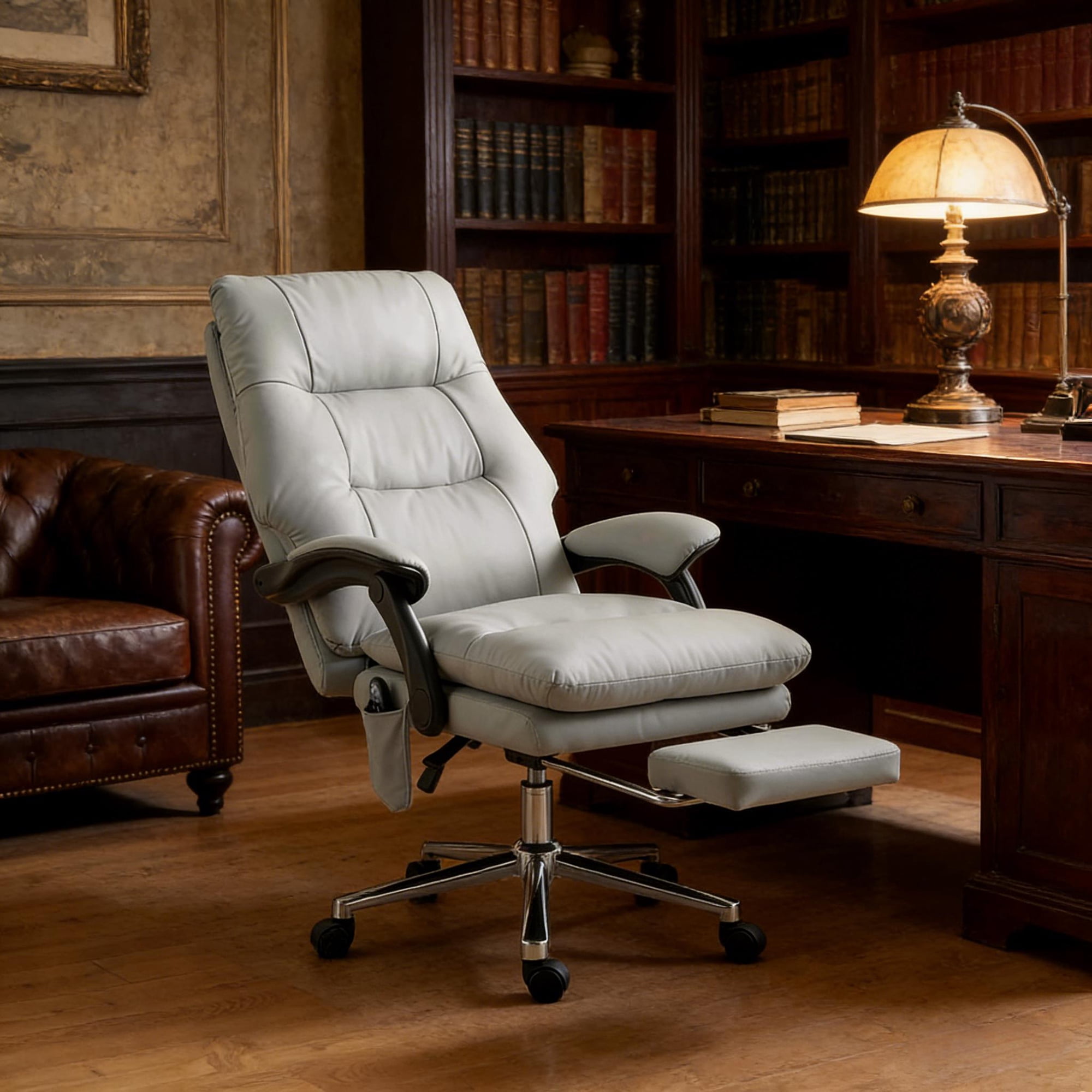
Poor armrests force you to hunch or elevate your shoulders. The healthiest office chair includes 4D armrests (height, width, depth, and pivot). But equally important: they should be able to move out of the way. Why? To allow you to pull the chair close to the desk, promoting a natural 90-degree elbow angle without lifting your shoulders. Look for armrests that are:
- Soft but firm (not hard plastic).
- Width-adjustable to accommodate different shoulder breadths.
- Pivotable to support forearms during typing or relaxing.
Beyond the Chair: The Concept of Active Seating
The absolute healthiest setup might not be a traditional chair at all — but rather a hybrid. Some of the healthiest office chairs incorporate elements of active seating:
Knee-Tilt Mechanism
The pivot point is at your knees, allowing your feet to stay grounded while your upper body moves freely. This engages thigh and core muscles.
Flexible Back Frame
Instead of a stiff shell, the back has flexible zones that twist slightly as you move, mimicking the spine's natural rotation.
Perch & Stool Hybrid
Some healthiest options are active stools that force micro-adjustments. For desk work, chairs with a slight forward tilt option replicate this effect.
Healthiest Materials Compared: Data-Driven Choice
To help you decide, here’s a quick comparison of how materials impact health factors:
| Material | Breathability | Pressure Distribution | Maintenance for Hygiene |
|---|---|---|---|
| High-Tensile Mesh | Excellent (10/10) | Good with even tension | Vacuum easily; dust can settle |
| Perforated Leather | Good (7/10) | Very Good (conforms) | Wipe clean; hypoallergenic |
| Premium Fabric | Moderate (6/10) | Excellent (plush) | May trap allergens; washable covers ideal |
| Standard Foam | Poor (3/10) | Good initially, degrades | Can retain odors; not ideal |
Frequently Asked Questions About the Healthiest Office Chair
Conclusion: Invest in the Chair That Invests in Your Body
Selecting the healthiest office chair is not a luxury—it's a long-term investment in your physical well-being. Your chair is the platform from which you work, create, and lead. A chair with inadequate support is like wearing shoes that are a half-size too small: you might not notice the damage immediately, but over months and years, the cumulative effect is real.
Focus on adjustability, breathability, and a design that invites movement. Remember, the healthiest chair is one that fits your unique body dimensions and work style. Use the recommendations above as a checklist, and whenever possible, test a chair's adjustments yourself. Your spine—and your future self—will thank you.